conductors of electricity
Rather than measure small wire sizes in inches, the unit of “mil” (1/1000 of an inch) is often employed. The cross-sectional area of a wire can be expressed in terms of square units (square inches or square mils), circular mils, or “gauge” scale.
› chpt-12 › conductor-size
Why is there insulation around wires?
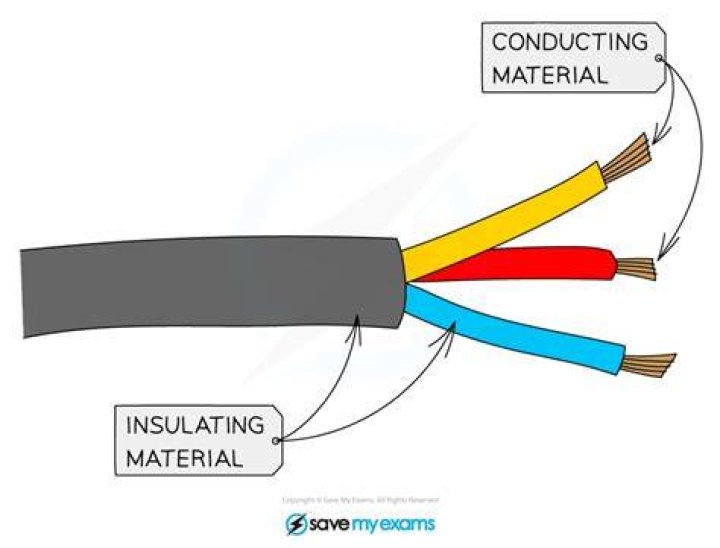
Cable and wire insulation prevents the wire's current from coming into contact with other conductors, it preserves the wire material against environmental threats and resists electrical leakage. There are three major categories of wire insulation, each with a variety of styles.
What is the purpose of the coating on electrical wires?
They are cured onto the wires with heat. The resulting coating's main function is electrical insulation. Wire enamels are also described as primary insulation. The coated wires are sometimes called “magnet wires”.
What is the plastic around a wire called?
The name of the plastic connector with an interior copper spring you twist over the end of bare electrical wire end(s) to secure them and prevent short circuits is a marrette.
Which is the protective layer over the insulated cable?
Cables are usually provided with an outer polymer coating for protection. This is called the “outer sheath”.
What Causes Wire Insulation to Fail?
Why insulation is important in electrical?
In addition to preventing electric shock, insulation also protects the materials through which electric current flows. Electrical insulation limits current flow between different electrical conductors. Importantly, there is no perfect electrical insulation material.
Why is insulation needed?
Insulation in your home provides resistance to heat flow and lowers your heating and cooling costs. Properly insulating your home not only reduces heating and cooling costs, but also improves comfort.
Why are insulating materials needed in electrical systems?
Purpose of an insulator is to prevent the unwanted flow of current from the energized conductor or conducting parts. Electrical insulation plays a vital role in every electrical system. An electrical insulator provides very high resistance so that practically no current can flow through it.
Why are power cables shielded?
The grounded shield equalizes electrical stress around the conductor, diverts any leakage current to ground. Be sure to apply stress relief/ cones at the shield ends, especially for cables operating at more than 2Kv to earth.
Should shielding be grounded?
The cable shielding and its termination must provide a low-impedance path to ground. A shielded cable that is not grounded does not work effectively. Any disruptions in the path can raise the impedance and lower the shielding effectiveness.
What is the cable jacket?
What is a Cable Jacket? A jacket is the outermost layer of a cable whose primary function is to protect the insulation and conductor core from external physical forces and chemical deterioration. In a sense, the cable jacket is the first line of mechanical defense for a cable by protecting its inner components.
Why are some cables sheathed?
Vulcanised Indian Rubber (VIR) cable is a copper conductor that is insulated with vulcanised rubber. The rubber insulation is then covered with a wax-impregnated cotton sheath to protect the cable from moisture damage.
Why must the plastic from the ends of the wire be cut off?
We remove the plastic coating from ends of an electric wire while using it for connections in an electric circuit because plastics are bad conductor or insulator of electricity due to which it prevents us from electric shocks.
Why are electrical wires covered with PVC?
They do not allow an electric current to pass through them so that even if we happened to touch the electric wires, the current should not pass through our body and hence we will not get an electric shock. is an insulator so to prevent us from getting electric shocks wires are coated with PVC.